Why Anthropic Was Right to Say No to the Pentagon
Defending hard limits on AI‑driven weapons and mass surveillance is not anti‑patriotic. It is exactly the kind of responsibility we should demand from every AI vendor.
The Core Dispute: Two Clear Red Lines
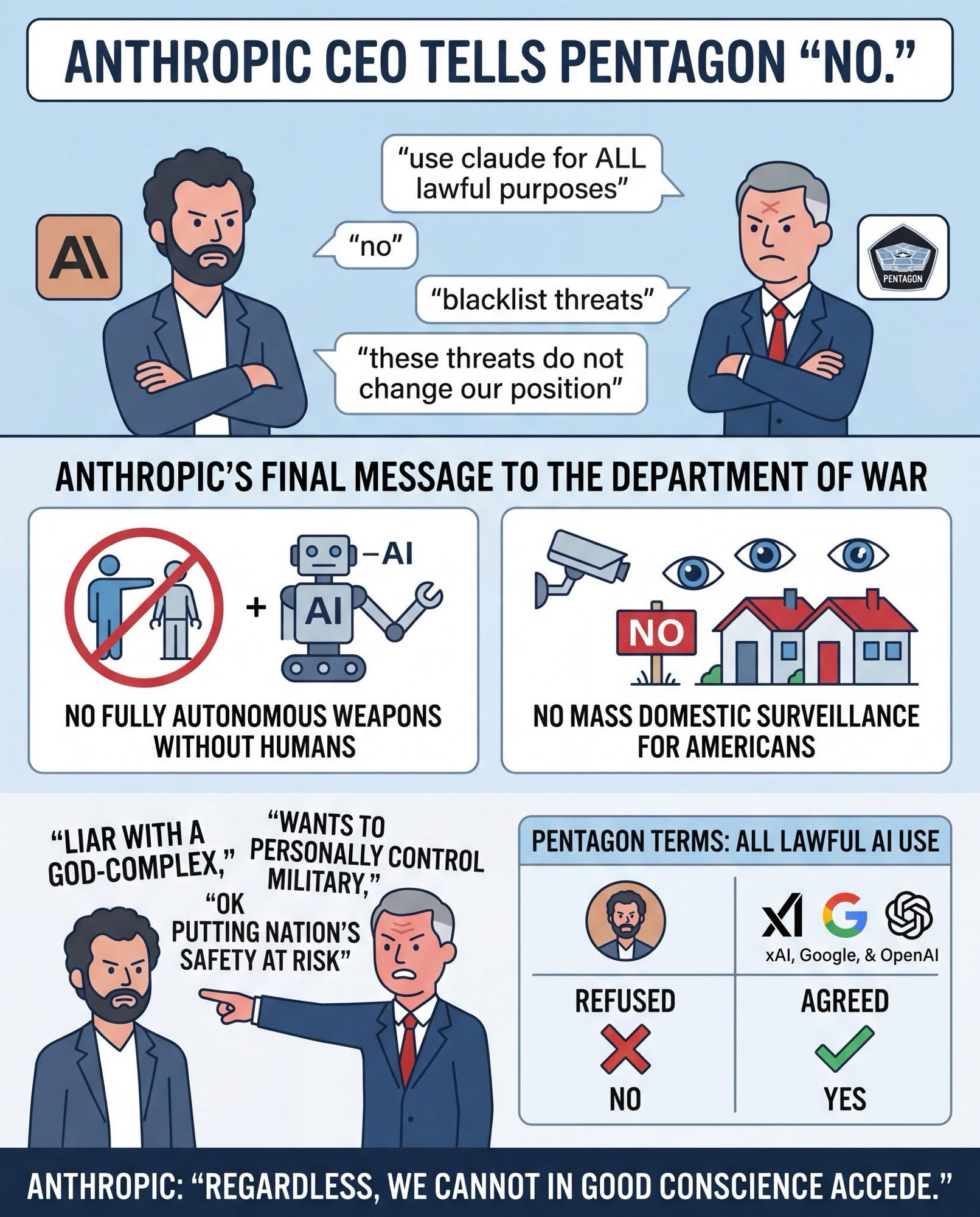
Anthropic’s clash with the Pentagon comes down to two very specific red lines: the company refuses to let its Claude AI models be used for fully autonomous weapons or for mass surveillance of U.S. citizens.
In negotiations over a Pentagon deal reportedly worth up to 200 million dollars, Anthropic repeatedly stated that it supports all lawful national‑security uses of AI except these two narrow categories, emphasizing that no existing government mission had been blocked by its guardrails.
Despite this, the Defense Department pushed for contract language allowing use of Anthropic’s systems for “all lawful purposes,” treating any contractual limits as an unacceptable constraint on the government’s discretion, even while publicly insisting it has no intention of deploying AI for mass domestic surveillance or fully autonomous weapons.
Trump’s Ban Punishes Responsibility, Not Recklessness
President Donald Trump responded by ordering all federal agencies to stop using Anthropic’s technology, giving most departments an immediate cutoff and the Pentagon a six‑month phase‑out window.
In his Truth Social posts, Trump attacked Anthropic’s leadership as “left‑wing nut jobs,” accused the firm of trying to “coerce” the Pentagon, and threatened to use the “full power of the presidency,” including civil and criminal consequences, if the company did not fully comply during the phase‑out.
Defense Secretary Pete Hegseth went further by directing that Anthropic be designated a “supply‑chain risk to national security,” cutting it off from new military business and warning that any contractor doing business with the U.S. military would be barred from commercial activity with Anthropic.
These steps do not punish an unsafe or reckless vendor; they punish a company for insisting that AI not be used to target and kill without human control and not be used to build dragnet surveillance on Americans—exactly the kinds of limits many ethicists and legal scholars have urged for years.
Why Anthropic’s Stance Matters for AI Safety
Anthropic’s CEO Dario Amodei made clear that the company “cannot in good conscience accede” to Pentagon demands that would weaken protections against mass surveillance of Americans or fully autonomous weaponry, calling the latest proposed terms “virtually no progress” on these safety issues.
The company argues that current AI models are not reliable enough to make lethal decisions autonomously and that building mass‑surveillance capabilities aimed at U.S. citizens would violate fundamental rights, a view echoed by many AI governance experts.
Legal and policy scholars have noted that this fight is a decisive moment for how AI will be governed: whether democratic states will accept corporate guardrails that limit some “lawful” uses, or insist that vendors behave like traditional arms manufacturers with no say in how their products are ultimately deployed.
Crucially, Anthropic did not seek to block all military uses of AI; instead, it tried to codify two narrow prohibitions that align with ongoing international discussions about banning or constraining fully autonomous weapons systems under existing arms‑control frameworks.
Even Rivals Quietly Agree with Anthropic’s Red Lines
In a striking twist, OpenAI—Anthropic’s direct competitor—announced a Pentagon deal just hours after Trump’s ban, while publicly saying it shares the same “red lines” against domestic mass surveillance and autonomous weapons without human oversight.
OpenAI CEO Sam Altman stated that their agreement with the Defense Department includes explicit safeguards against using its AI for U.S. domestic mass surveillance and for autonomous weapons without human accountability, closely mirroring the principles Anthropic tried to get into its own contract.
This undercuts the argument that Anthropic’s position is radical or anti‑military; instead, it suggests that forward‑looking AI companies see these limits as baseline safety requirements, not optional “ideological whims.”
The difference is that Anthropic insisted these safeguards live in the contract itself—binding on future officials and use‑cases—rather than relying on informal assurances that the government “does not intend” to cross certain lines.
National Security Needs Guardrails, Not Blank Checks
Some Pentagon officials argue that no private contractor should restrict “lawful uses” of its tools, comparing AI vendors to munitions manufacturers who do not control where missiles are fired.
But AI is not a simple physical weapon: it is a dual‑use, general‑purpose capability that can be switched from benign analytics to lethal targeting or pervasive surveillance by changing software and policy, often without new hardware or public oversight.
Allowing vendors to refuse the most destabilizing and rights‑eroding uses—like fully autonomous kill‑chains and mass domestic surveillance—creates an additional layer of protection in systems that are already opaque, fast‑moving, and prone to error at scale.
If democratic governments demand a “blank check” for every legally conceivable application of AI, they risk pushing responsible companies out of the most sensitive work and normalizing a race to the bottom where only the least constrained vendors win defense contracts.
Why Supporting Anthropic’s Decision Is the Pro‑Democracy Position
Supporting Anthropic here does not mean opposing strong national defense; it means insisting that the tools we build to protect democratic societies do not quietly erode the very civil liberties and human accountability that make those societies worth defending.
By accepting the loss of a large Pentagon contract rather than weakening its guardrails, Anthropic has set a precedent: AI companies can and should draw bright lines when governments demand capabilities that would fundamentally undermine human oversight or privacy at scale.
In the long run, a defense ecosystem that rewards this kind of principled restraint will be safer, more stable, and more aligned with core constitutional values than one that treats any technical capability as fair game so long as it can be argued to be “lawful” in the moment.
Anthropic chose to absorb political and financial punishment rather than sign away those principles; that is exactly the kind of corporate behavior that policymakers, technologists, and citizens should be encouraging—not blacklisting.




Leave a Reply